ESM_project

Path model

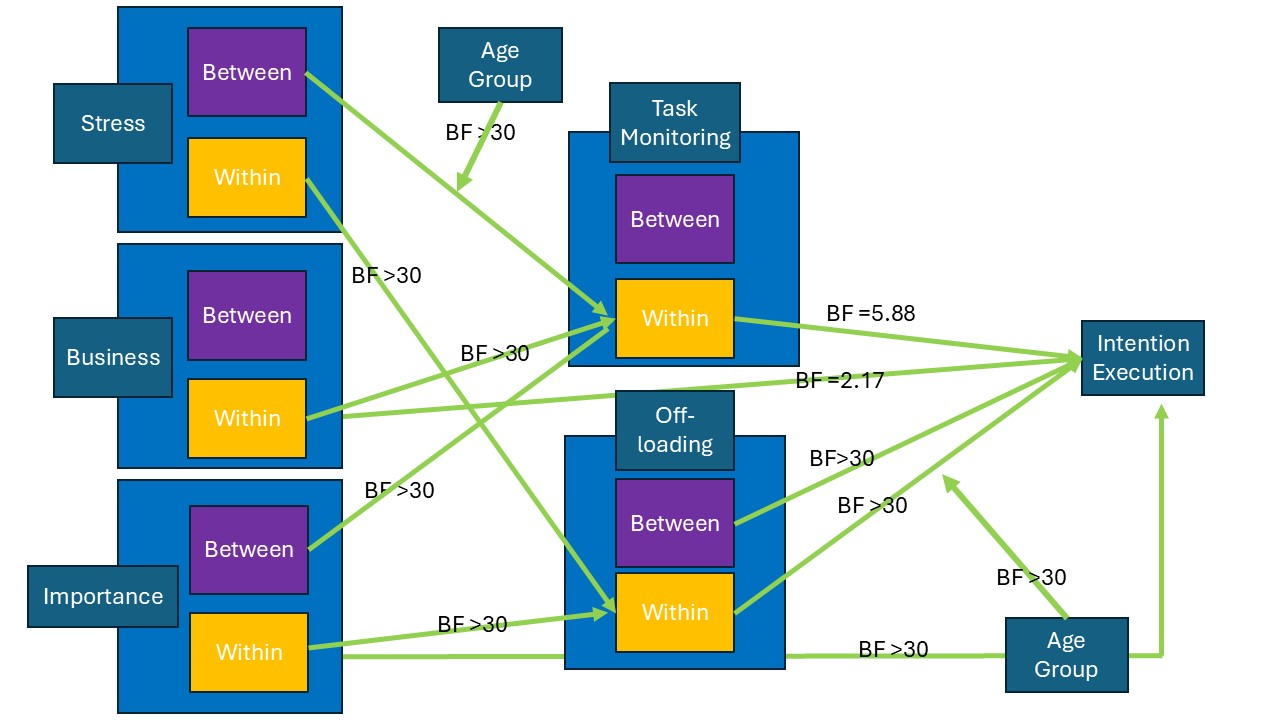
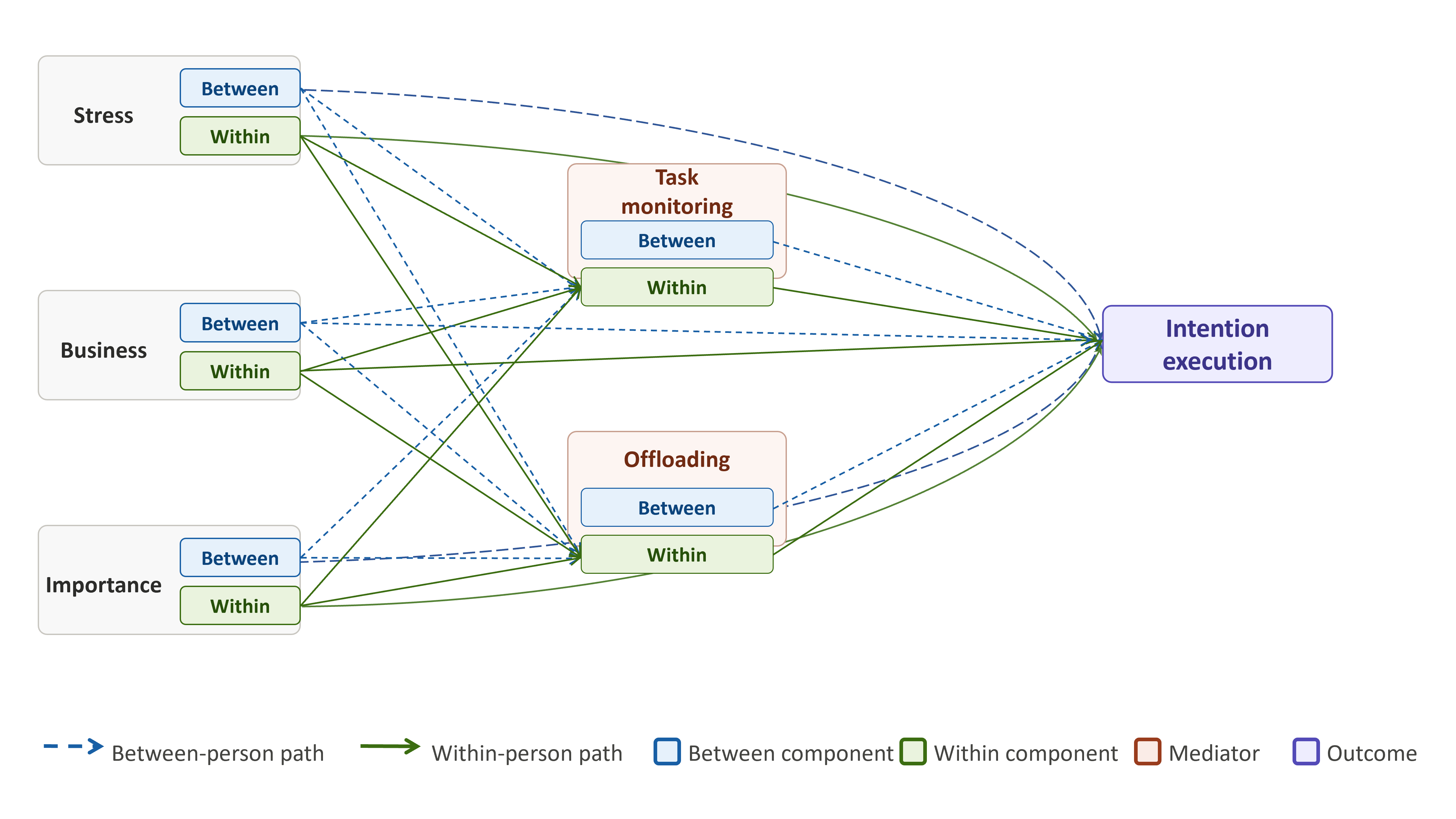
The tested path model Figure 1. Hypothesised path model

Code
# Import the data
#| include: false
#| message: false
#| warning: false
#| echo: false
cd<-getwd()

# file dir
file_dir<-"Originaldatensätze/R-Skript"

# young adults' dataset
YA_df<- read_spss(paste0(file_dir, "/ExpSamp_jungErw2.sav"))

# rename the age group
YA_df$agegroup<-"YA"

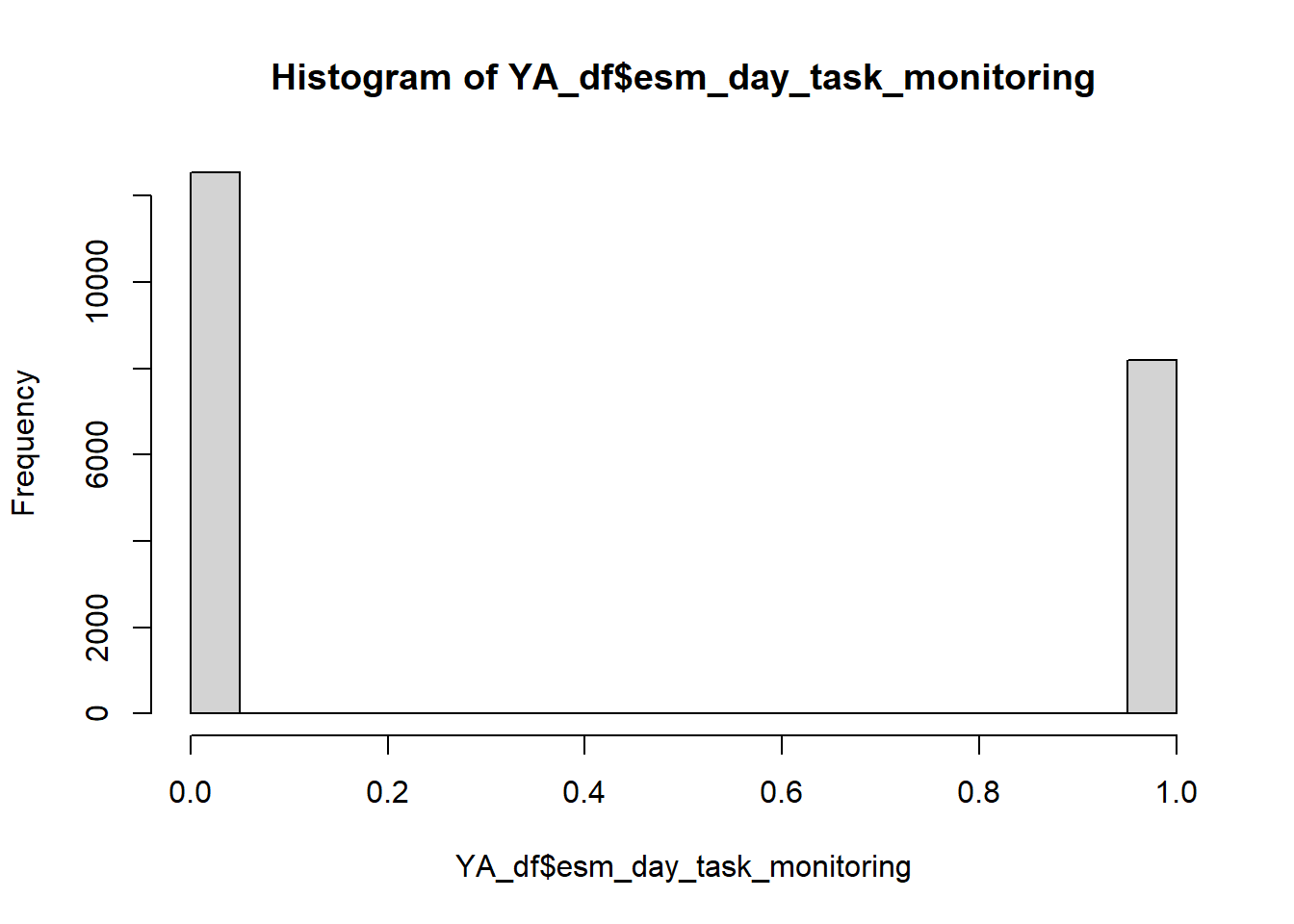
# check task_monitoring
hist(YA_df$esm_day_task_monitoring)

Code
# middle-aged adults
MAA_df<-read_spss(paste0(file_dir, "/ExpSamp_mittlErw.sav"))

# rename the age group
MAA_df$agegroup<-"MAA"

# check task_monitoring
hist(YA_df$esm_day_task_monitoring)

# combine the two
all_df<-rbind(YA_df, MAA_df)

Participants

Code
all_df %>%
  distinct(ID, agegroup) %>%
  count(agegroup, name = "n_participants") %>%
  gt() %>%
  tab_header(
    title = "Participants by age group"
  )
Participants by age group
agegroup n_participants
MAA 103
YA 107
Code
# check the length of unique IDs
length(unique(all_df$ID))
[1] 210

the df looks like this:

# A tibble: 20 × 15
   ID         day  time intention                esm_day_stress esm_day_business
   <chr>    <dbl> <dbl> <chr>                             <dbl>            <dbl>
 1 AM05UN20     1     1 Brief abgeben                         3                2
 2 AM05UN20     1     2 Brief abgeben                         4                3
 3 AM05UN20     1     3 Brief abgeben                         4                5
 4 AM05UN20     1     4 Brief abgeben                         4                4
 5 AM05UN20     1     5 Brief abgeben                        NA               NA
 6 AM05UN20     1     1 Präsentation fertigstel…              3                2
 7 AM05UN20     1     2 Präsentation fertigstel…              4                3
 8 AM05UN20     1     3 Präsentation fertigstel…              4                5
 9 AM05UN20     1     4 Präsentation fertigstel…              4                4
10 AM05UN20     1     5 Präsentation fertigstel…             NA               NA
11 AM05UN20     1     1 Geschwister treffen                   3                2
12 AM05UN20     1     2 Geschwister treffen                   4                3
13 AM05UN20     1     3 Geschwister treffen                   4                5
14 AM05UN20     1     4 Geschwister treffen                   4                4
15 AM05UN20     1     5 Geschwister treffen                  NA               NA
16 AM05UN20     2     1 Kaffe trinken gehen                   2                2
17 AM05UN20     2     2 Kaffe trinken gehen                   2                3
18 AM05UN20     2     3 Kaffe trinken gehen                   4                4
19 AM05UN20     2     4 Kaffe trinken gehen                   5                5
20 AM05UN20     2     5 Kaffe trinken gehen                   5                5
# ℹ 9 more variables: esm_day_task_monitoring <dbl>, esm_day_stress_avg <dbl>,
#   esm_daybusiness_avg <dbl>, esm_day_task_monitoring_avg <dbl>,
#   esm_evening_intention_importance_t1 <dbl>, esm_evening_off_loading <dbl>,
#   esm_evening_intention_execution <dbl>, age_group <dbl>, agegroup <chr>

Preprocessing

  • Rescale PM to range between 0 and 1
Code
all_df$esm_evening_intention_execution<-ifelse(all_df$esm_evening_intention_execution ==-1, 0, all_df$esm_evening_intention_execution)

Monitoring

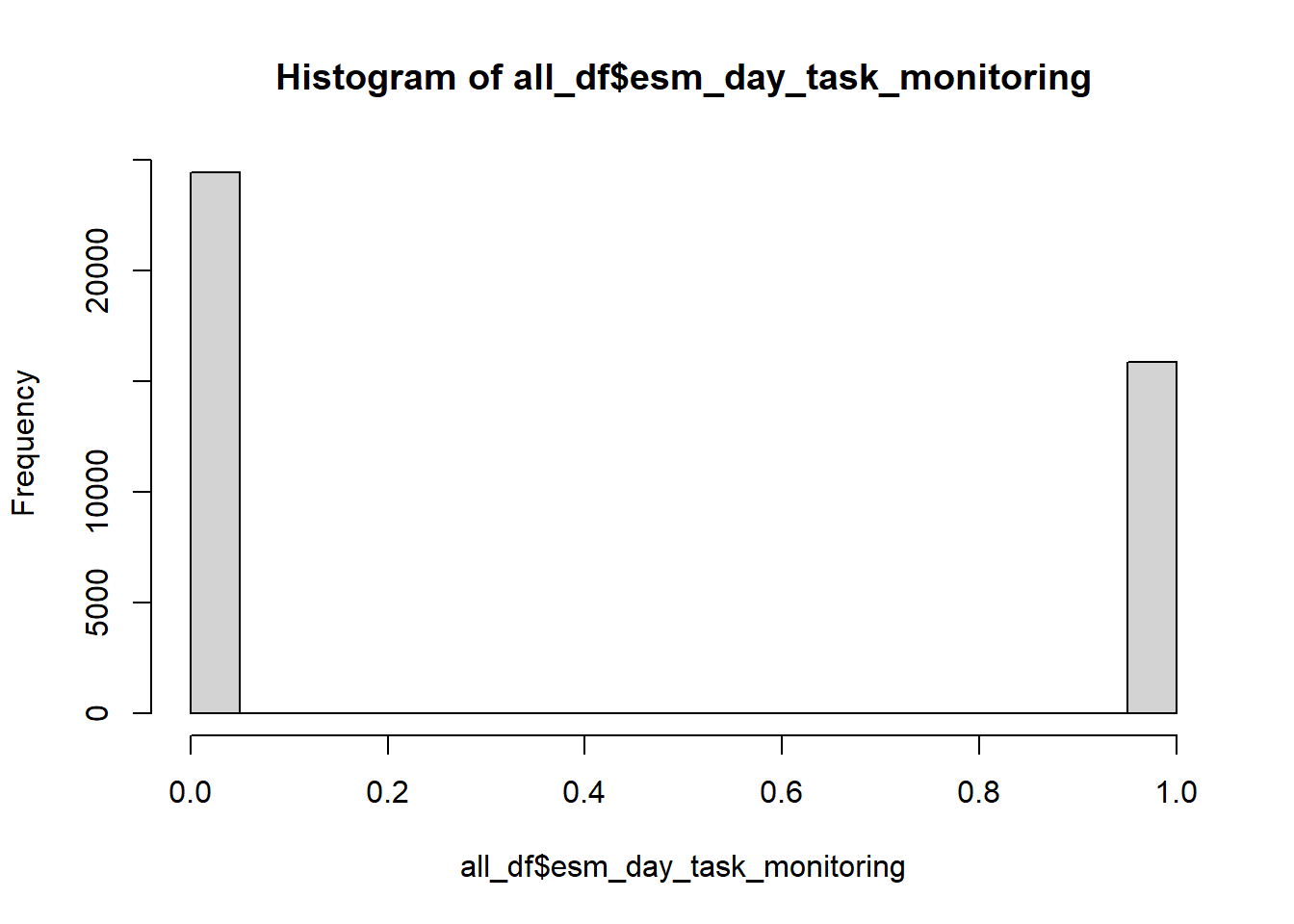
Code
hist(all_df$esm_day_task_monitoring)

Code
# all_df$esm_day_task_monitoring_r<-ifelse(all_df$esm_day_task_monitoring ==-1, 0, 
#                                          ifelse(all_df$esm_day_task_monitoring== 0, 0, 1))

Rescale offloading

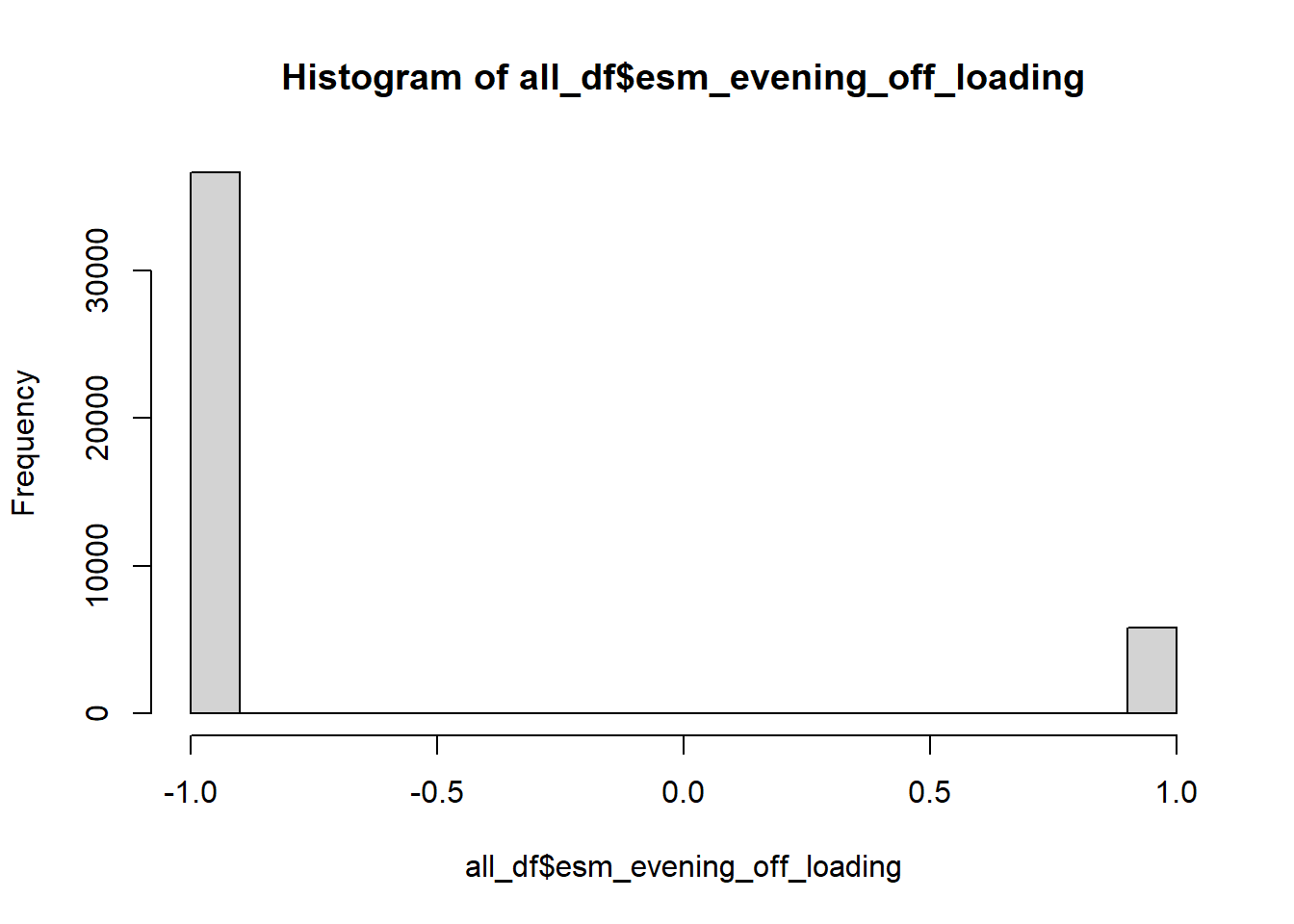
Code
hist(all_df$esm_evening_off_loading)

Code
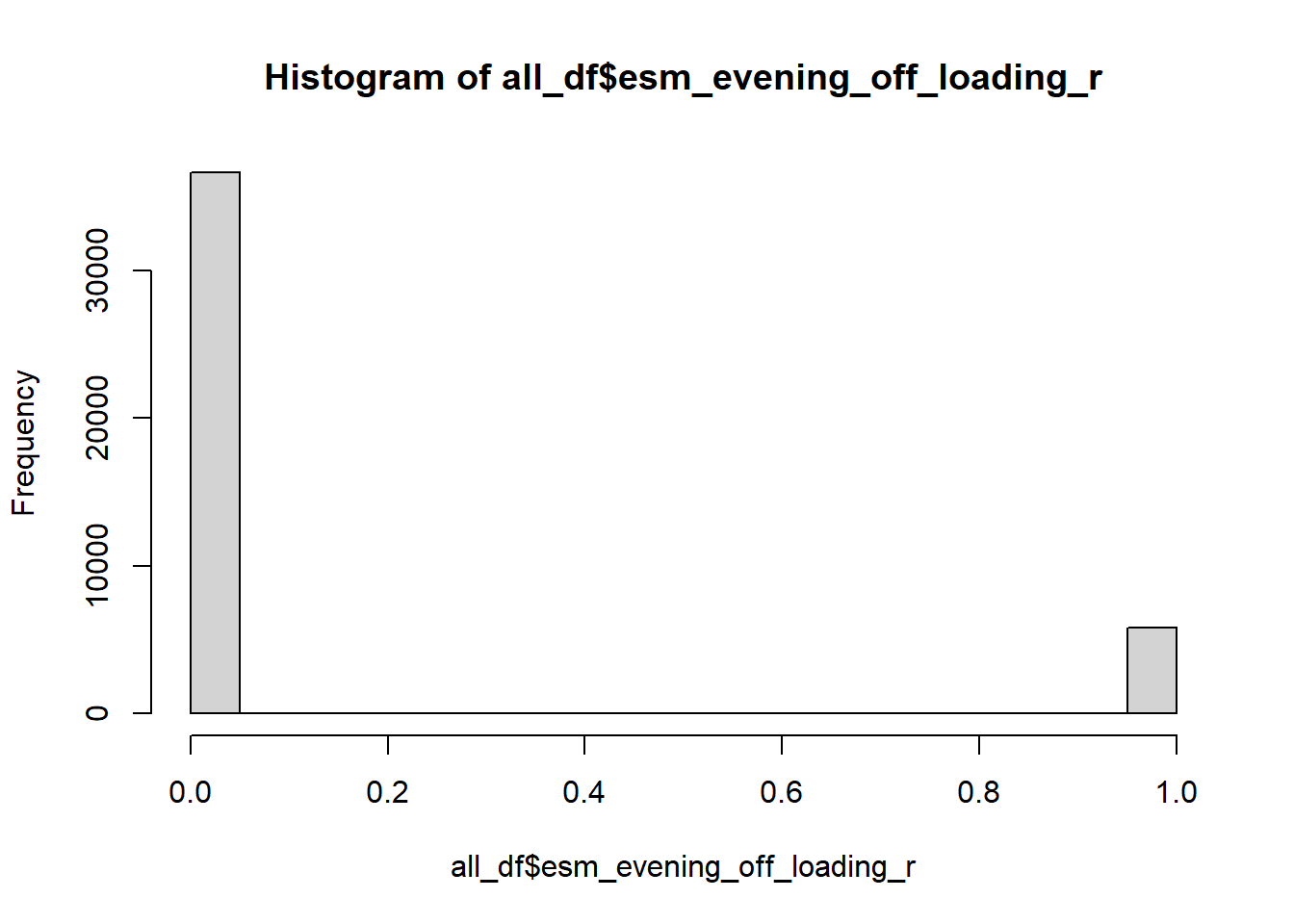
all_df$esm_evening_off_loading_r<-ifelse(all_df$esm_evening_off_loading ==-1, 0,1)

hist(all_df$esm_evening_off_loading_r)

Reshaping

  • The dataset as it is now is good to test hypotheses on the variables that vary within day, e.g. stress, business, monitoring.
  • Reshape the dataset so there is only one unique intention per day, which is our base level.

RTeshaped dataset

`summarise()` has regrouped the output.
ℹ Summaries were computed grouped by ID and day.
ℹ Output is grouped by ID.
ℹ Use `summarise(.groups = "drop_last")` to silence this message.
ℹ Use `summarise(.by = c(ID, day))` for per-operation grouping
  (`?dplyr::dplyr_by`) instead.
# A tibble: 20 × 43
# Groups:   ID, day, intention [20]
   ID         day  time intention                esm_day_stress esm_day_business
   <chr>    <dbl> <dbl> <chr>                             <dbl>            <dbl>
 1 AM05UN20     1     2 Brief abgeben                         4                3
 2 AM05UN20     1     3 Geschwister treffen                   4                5
 3 AM05UN20     1     5 Präsentation fertigstel…             NA               NA
 4 AM05UN20     2     3 Freund besuchen                       4                4
 5 AM05UN20     2     5 Kaffe trinken gehen                   5                5
 6 AM05UN20     2     3 telefonieren                          4                4
 7 AM05UN20     3     1 Präsentation fertigstel…              2                3
 8 AM05UN20     3     3 aufräumen                             4                5
 9 AM05UN20     3     1 mit Freundin spielen                  2                3
10 AM05UN20     4     4 13 Uhr zum Geburtstag g…              4                5
11 AM05UN20     4     2 mit guter Laune aufsteh…              4                5
12 AM05UN20     4     5 nicht einschüchtern las…              3                2
13 AM05UN20     5     3 18 Uhr bereitmachen für…              4                5
14 AM05UN20     5     2 Motivation zeigen                     3                4
15 AM05UN20     5     3 ausschlafen                           4                5
16 AM05UN20     6     3 Praktikumsplatz suchen                4                4
17 AM05UN20     6     5 Präsentation fertigstel…              2                4
18 AM05UN20     6     1 mit Freunden treffen                  2                4
19 AM05UN20     7     1 Präsentation fertigstel…              5                5
20 AM05UN20     7     3 meinem Freund eine Freu…              4                4
# ℹ 37 more variables: esm_day_task_monitoring <dbl>, esm_day_stress_avg <dbl>,
#   esm_daybusiness_avg <dbl>, esm_day_task_monitoring_avg <dbl>,
#   esm_evening_intention_importance_t1 <dbl>, esm_evening_off_loading <dbl>,
#   esm_evening_intention_execution <dbl>, age_group <dbl>, agegroup <chr>,
#   esm_evening_off_loading_r <dbl>, mean_stress <dbl>, mean_business <dbl>,
#   grand_mean_esm_stress <dbl>, grand_sd_esm_stress <dbl>,
#   grand_mean_esm_day_business <dbl>, grand_sd_esm_day_business <dbl>, …

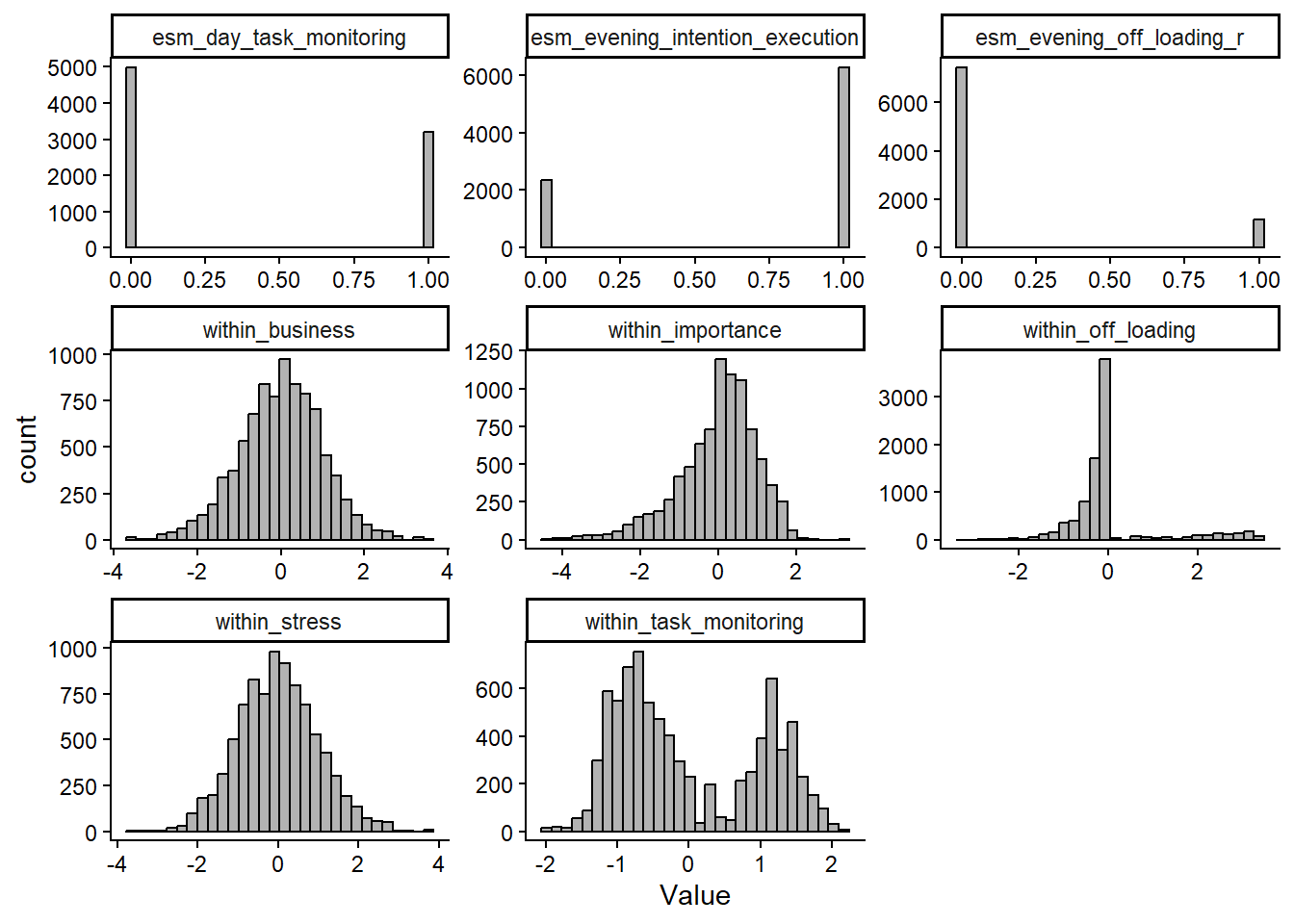
Distributions

Code
# Select the variables you want histograms for
df_selected <- stress_int_red %>%
  select(within_stress, within_importance, within_business, 
         within_off_loading, within_task_monitoring, 
         esm_evening_intention_execution,esm_day_task_monitoring,esm_evening_off_loading_r )  
Adding missing grouping variables: `ID`, `day`, `intention`
Code
df_selected<-df_selected[, c("within_stress", "within_importance", "within_business", 
                             "within_off_loading", "within_task_monitoring", 
                             "esm_evening_intention_execution", "esm_day_task_monitoring", 
                             "esm_evening_off_loading_r")]

# Convert to long format
df_long <- df_selected %>%
  pivot_longer(cols = everything(), names_to = "Variable", values_to = "Value")

# Plot all histograms in one go using facets
ggplot(df_long, aes(x = Value)) +
  geom_histogram(bins = 30, fill = "grey70", color = "black") +
  facet_wrap(~ Variable, scales = "free") +
  theme_classic()
Warning: Removed 1952 rows containing non-finite outside the scale range
(`stat_bin()`).

Check the intraclass correlation coefficient (ICC)

Code
PM_YA <- glmer(esm_evening_intention_execution ~ 1 + (1 | ID), 
               data = stress_int[stress_int$agegroup=="YA",], family = binomial)

PM_MAA <- glmer(esm_evening_intention_execution ~ 1 + (1 | ID), 
                data = stress_int[stress_int$agegroup=="MAA",], family = binomial)

print("ICC PM YA:")
[1] "ICC PM YA:"
Code
icc_YA<-icc(PM_YA)
icc_YA$ICC_adjusted
[1] 0.1332206
Code
print("ICC PM MAA:")
[1] "ICC PM MAA:"
Code
icc_MAA<-icc(PM_MAA)
icc_MAA$ICC_adjusted
[1] 0.1889952

Test the effect of day on intention execution

  esm_evening_intention_execution
Predictors Odds Ratios CI p
(Intercept) 2.93 2.65 – 3.25 <0.001
day c 1.02 1.00 – 1.03 0.034
agegroup c 1.46 1.20 – 1.79 <0.001
day c × agegroup c 0.99 0.97 – 1.02 0.534
Random Effects
σ2 3.29
τ00 ID 0.42
τ11 ID.day.c 0.00
ρ01 ID 0.07
ICC 0.12
N ID 210
Observations 8627
Marginal R2 / Conditional R2 0.011 / 0.127

Do people become more stressed as the go on with the study?

Code
stress_time_model<-lmer(esm_day_stress_avg ~ day.c*agegroup.c + (day.c|ID), 
                        data = stress_int_red, 
                        control=lmerControl(optimizer="bobyqa",optCtrl=list(maxfun=100000)) )

tab_model(stress_time_model)
  esm_day_stress_avg
Predictors Estimates CI p
(Intercept) 2.44 2.37 – 2.52 <0.001
day c 0.01 0.01 – 0.02 0.001
agegroup c -0.01 -0.16 – 0.14 0.867
day c × agegroup c -0.01 -0.02 – 0.01 0.289
Random Effects
σ2 0.34
τ00 ID 0.29
τ11 ID.day.c 0.00
ρ01 ID 0.03
ICC 0.49
N ID 210
Observations 8623
Marginal R2 / Conditional R2 0.004 / 0.492

Results

Generalized linear-mixed effect path model - bayesian estimation

Code
# first, we predict PM from all the predictors
PM_model <-bf(esm_evening_intention_execution ~  # fixed effects 
                within_stress*agegroup.c + 
                within_importance*agegroup.c + 
                within_task_monitoring*agegroup.c + 
                within_off_loading*agegroup.c +
                within_business*agegroup.c+
                between_stress*agegroup.c + 
                between_task_monitoring*agegroup.c + 
                between_off_loading*agegroup.c +
                between_importance*agegroup.c+
                between_business*agegroup.c+day.c+
                (1 + within_stress +
                   within_business+
                   within_importance + 
                   within_task_monitoring + 
                   within_off_loading || ID), # random intercepts and slopes
              family = bernoulli()) # we have a binary outcome

# predicting monitoring from stress and importance
monitoring_model<- bf(esm_day_task_monitoring ~ 
                        within_stress*agegroup.c +
                        within_importance*agegroup.c +
                        within_business*agegroup.c+
                        between_stress*agegroup.c+
                        between_importance*agegroup.c+
                        between_business+day.c+
                        (1+within_stress+
                           within_business+
                           within_importance+
                           day.c||ID), 
                      family = bernoulli()) # mixture

# predicing off_loading from stress and imortance
offloading_model<-bf(esm_evening_off_loading_r ~ 
                       within_stress*agegroup.c +
                       within_importance*agegroup.c+
                       within_business*agegroup.c+
                       between_stress*agegroup.c+
                       between_importance*agegroup.c+
                       between_business*agegroup.c+ day.c+
                       (1+within_stress+
                          within_importance+
                          within_business+
                          day.c||ID), family = bernoulli() )#

# set weakly informative priors
priors <- c(
  # Fixed effects: assume standardized predictors
  prior(normal(0, 0.5), class = "b", resp = "esmeveningintentionexecution"),   
  prior(normal(0, 0.5), class = "b", resp = "esmdaytaskmonitoring"),  
  prior(normal(0, 0.5), class = "b", resp = "esmeveningoffloadingr")   
  
# all the rest is left as defauls
 #  
 #  # SD of random effects (hierarchical structure)
 #   prior( student_t(3, 0, 2.5) , class = "sd", resp = "esmeveningintentionexecution"),
 #  prior(student_t(3, 0, 2.5) , class = "sd", resp = "esmdaytaskmonitoring"),
 #   prior(student_t(3, 0, 2.5), class = "sd", resp = "esmeveningoffloadingr"),
 #  #
 #  # Correlation priors among random effects
 # # prior(lkj(2), class = "cor"),  # same across responses
 # 
 #  # Residual SDs for continuous outcomes
 #  prior(exponential(1), class = "sigma", resp = "esmdaytaskmonitoring"),
 #  prior(exponential(1), class = "sigma", resp = "esmeveningoffloadingr")
)


# fit the model
fit1 <- brm(
  PM_model+
    monitoring_model + 
    offloading_model + 
    set_rescor(F), 
  prior = priors,
  sample_prior = "yes",
  data = stress_int_red,
  chains = 4, cores = 4,
  iter = 2000, 
  warmup = 1000

)
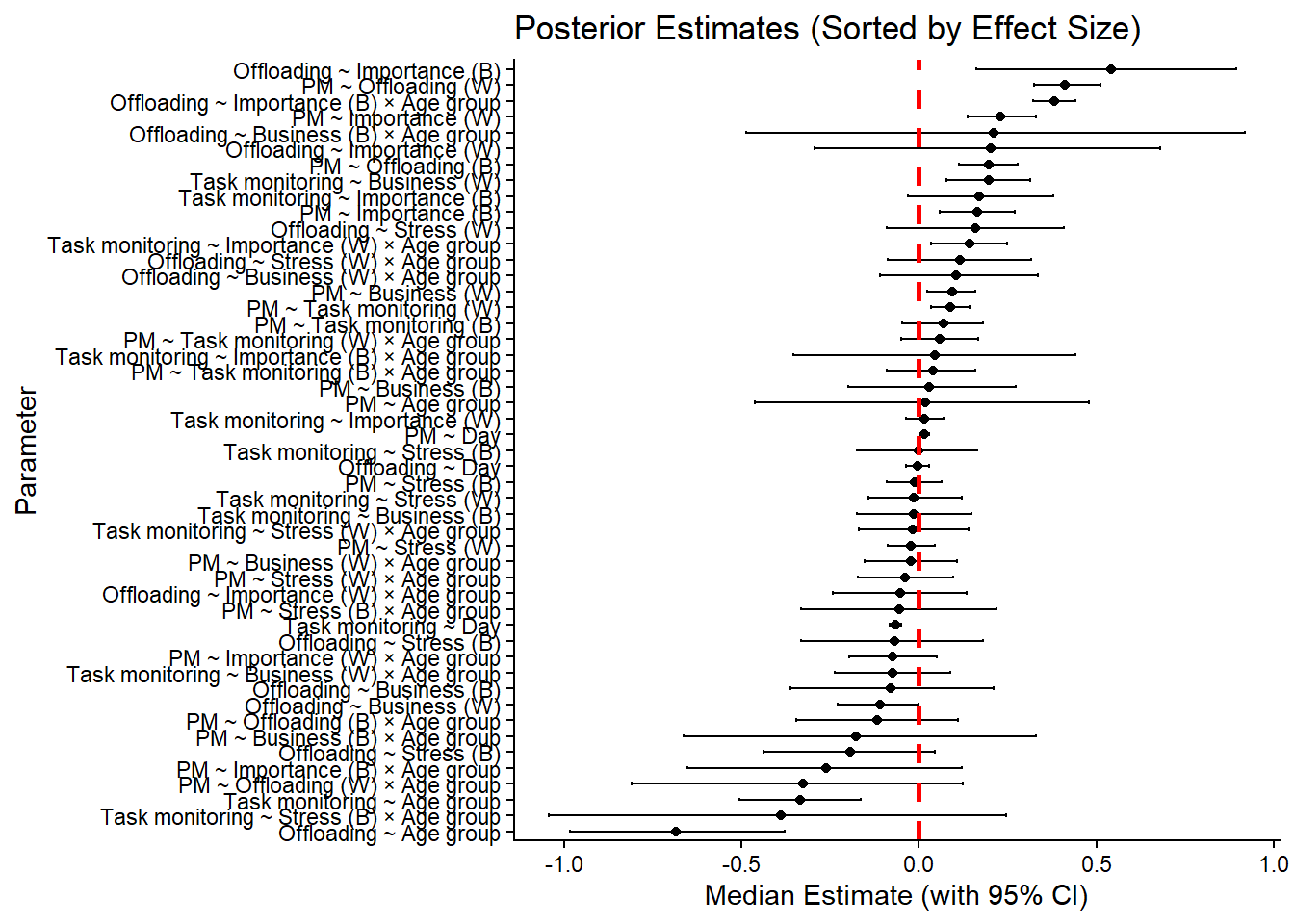
Posterior summary

Path model results

Extended hypothesised path model

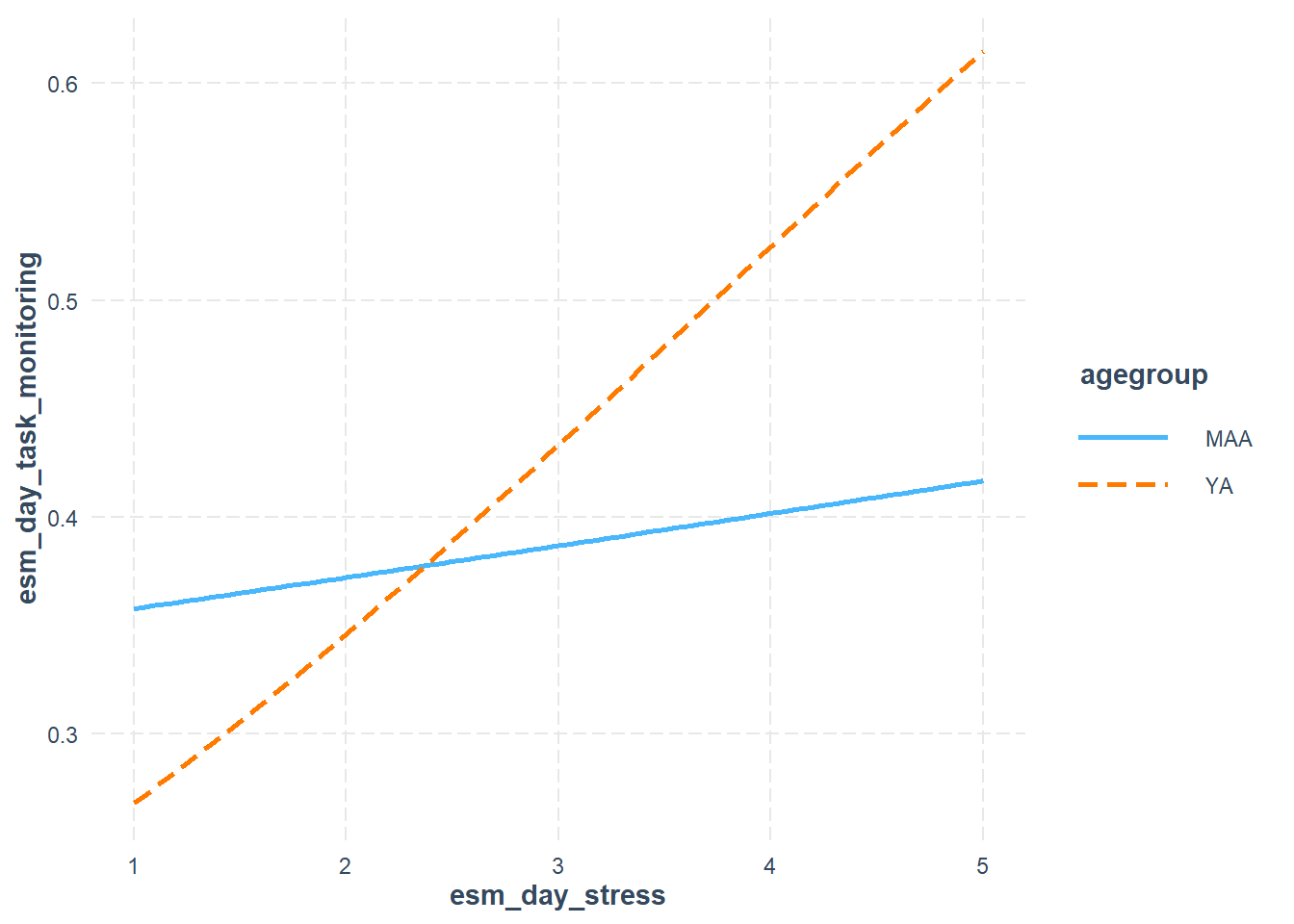
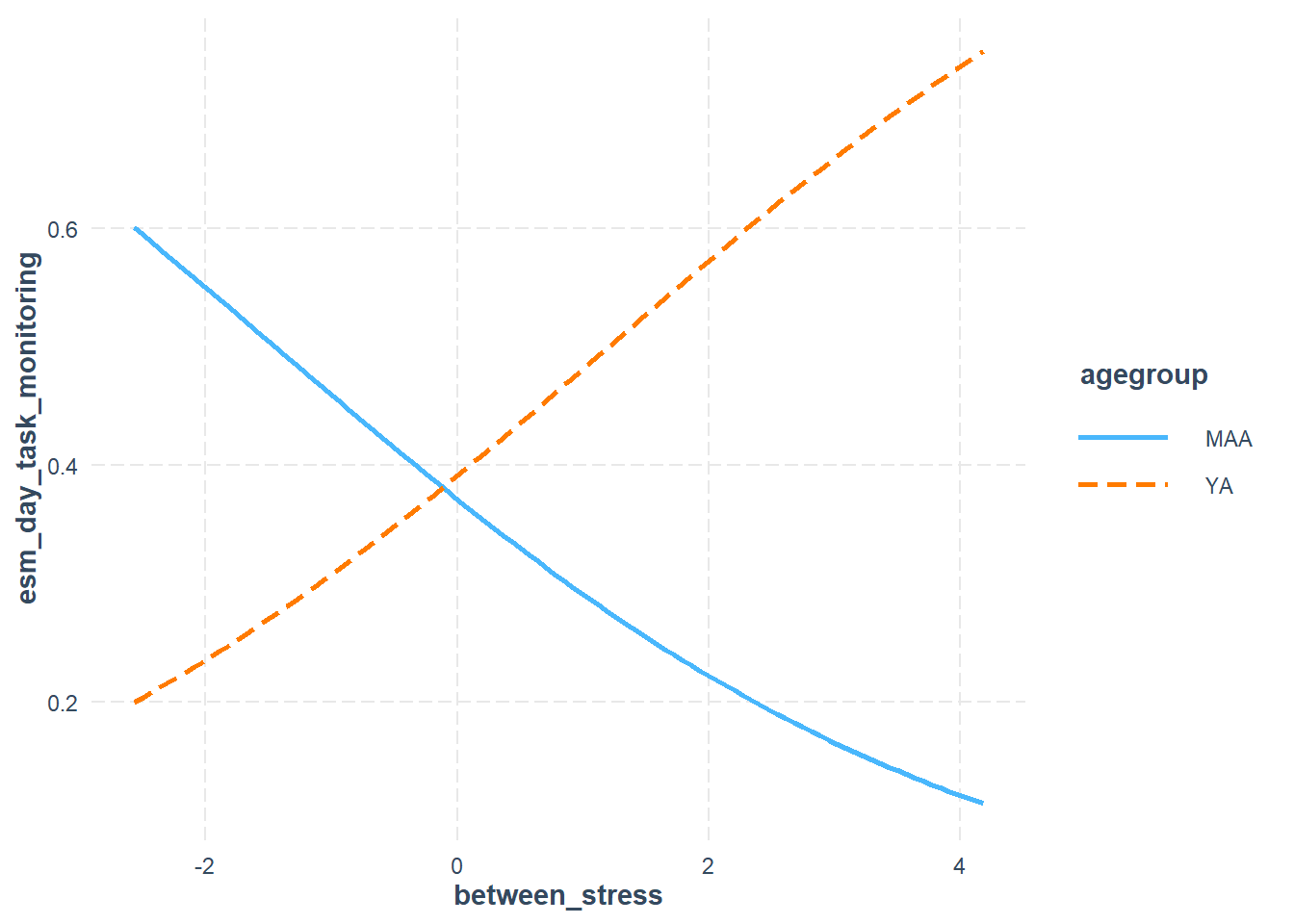
Moderation of Age group on between stress-within task monitoring path

Code
int_mod_stess_mon<-glmer(esm_day_task_monitoring~between_stress*agegroup +(1|ID),
               family = binomial(),
               data = stress_int_red, )


tab_model(int_mod_stess_mon)
  esm_day_task_monitoring
Predictors Odds Ratios CI p
(Intercept) 0.59 0.49 – 0.71 <0.001
between stress 0.69 0.58 – 0.83 <0.001
agegroup [YA] 1.09 0.83 – 1.42 0.536
between stress × agegroup
[YA]
2.08 1.57 – 2.76 <0.001
Random Effects
σ2 3.29
τ00 ID 0.82
ICC 0.20
N ID 210
Observations 8171
Marginal R2 / Conditional R2 0.032 / 0.225
Code
int_mod_stress_mon<-glmer(esm_day_task_monitoring~day.c+ esm_day_stress*agegroup +(1+day.c+esm_day_stress|ID),
               family = binomial(),
               data = stress_int_red )
boundary (singular) fit: see help('isSingular')
Code
tab_model(int_mod_stress_mon)
  esm_day_task_monitoring
Predictors Odds Ratios CI p
(Intercept) 0.52 0.40 – 0.68 <0.001
day c 0.93 0.92 – 0.94 <0.001
esm day stress 1.06 0.97 – 1.17 0.194
agegroup [YA] 0.48 0.34 – 0.69 <0.001
esm day stress × agegroup
[YA]
1.36 1.19 – 1.55 <0.001
Random Effects
σ2 3.29
τ00 ID 0.96
τ11 ID.day.c 0.00
τ11 ID.esm_day_stress 0.11
ρ01 1.00
-0.45
N ID 210
Observations 8171
Marginal R2 / Conditional R2 0.049 / NA
Code
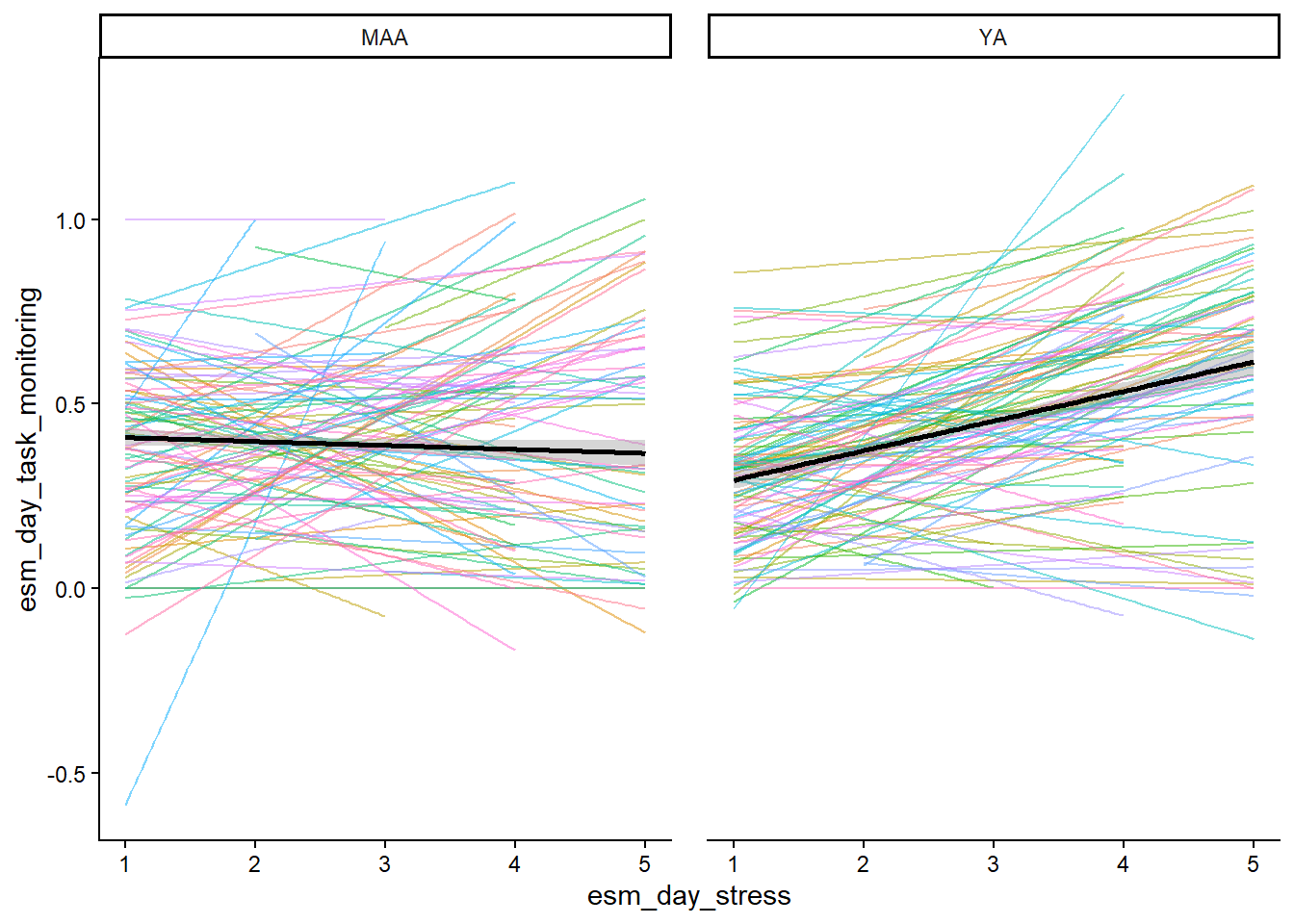
interact_plot(int_mod_stress_mon, pred = esm_day_stress, modx = agegroup)

Code
 ggplot(stress_int_red, 
         aes( x=esm_day_stress, y=esm_day_task_monitoring))+
  # add the "smooth" line, which the regression method ('l,')
  # and trasparent (0.5)
    geom_line(stat="smooth",method = "glm", formula=y~x, alpha=0.5, se=F)+

  # specify that we want different colours for different participants
    aes(colour = factor(ID))+
  # add the summary line with geom_smooth
    geom_smooth(method="lm",formula=y~x, se=T, colour = "black" )+
    theme(strip.text.x = element_text(size = 13))+
    theme_classic()+
    theme(panel.spacing = unit(1, "lines"))+
    facet_wrap(.~agegroup)+
    #ggtitle("Experiment 2")+
    theme(legend.position = "none")
Warning: Removed 635 rows containing non-finite outside the scale range
(`stat_smooth()`).
Removed 635 rows containing non-finite outside the scale range
(`stat_smooth()`).

Plot moderation of Age group on between stress-within task monitoring path

Code
interact_plot(int_mod_stess_mon, pred = between_stress, modx = agegroup)

Test the mediation of monitoring

Code
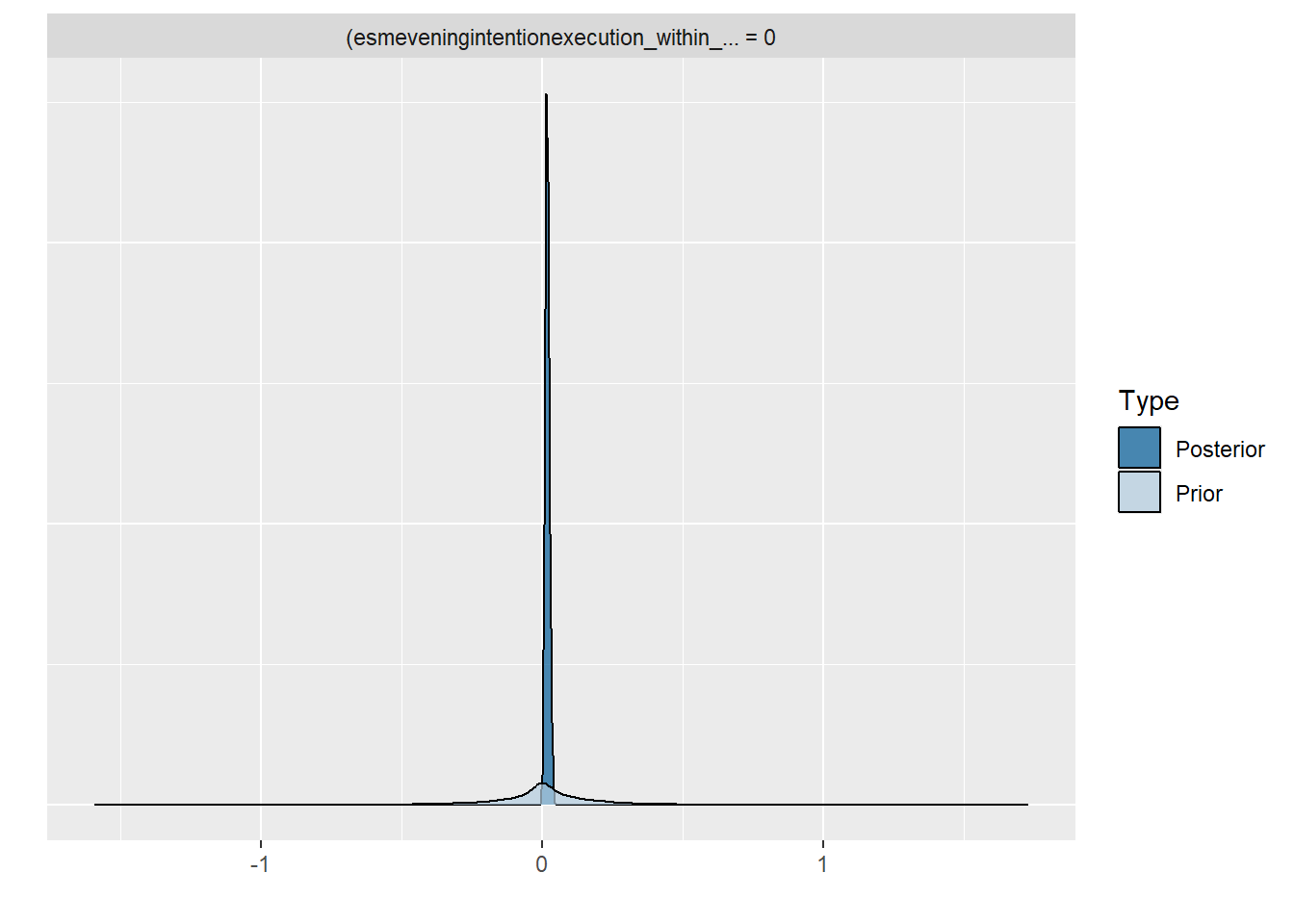
h_business_monitoring<-hypothesis(fit1,  c("esmeveningintentionexecution_within_task_monitoring*esmdaytaskmonitoring_within_business =0"  ))

plot(h_business_monitoring)

Code
print(h_business_monitoring)
Hypothesis Tests for class b:
                Hypothesis Estimate Est.Error CI.Lower CI.Upper Evid.Ratio
1 (esmeveningintent... = 0     0.02      0.01     0.01     0.03       0.18
  Post.Prob Star
1      0.15    *
---
'CI': 90%-CI for one-sided and 95%-CI for two-sided hypotheses.
'*': For one-sided hypotheses, the posterior probability exceeds 95%;
for two-sided hypotheses, the value tested against lies outside the 95%-CI.
Posterior probabilities of point hypotheses assume equal prior probabilities.
Code
print(paste0("Bayes Factor for ", "h_mediation"," is ", 1/h_business_monitoring$hypothesis$Evid.Ratio))
[1] "Bayes Factor for h_mediation is 5.56821630181082"

Test moderated mediation - Age as moderator, off-loading as a mediator

Code
h_moderated_mediation<-hypothesis(fit1,  c("esmeveningintentionexecution_agegroup.c:within_off_loading* esmeveningoffloadingr_within_importance = 0"  ))

BF_moderated_med<-1/h_moderated_mediation$hypothesis$Evid.Ratio
print(paste0("Bayes Factor for ", "h_moderated_mediation"," is ", 1/h_moderated_mediation$hypothesis$Evid.Ratio))

Moderation model

Generalized linear mixed model fit by maximum likelihood (Laplace
  Approximation) [glmerMod]
 Family: binomial  ( logit )
Formula: esm_evening_intention_execution ~ within_off_loading * agegroup +  
    (within_off_loading | ID)
   Data: stress_int_red

      AIC       BIC    logLik -2*log(L)  df.resid 
   9571.4    9620.9   -4778.7    9557.4      8619 

Scaled residuals: 
    Min      1Q  Median      3Q     Max 
-3.6160 -0.9707  0.4621  0.6220  2.0074 

Random effects:
 Groups Name               Variance Std.Dev. Corr  
 ID     (Intercept)        0.43321  0.6582         
        within_off_loading 0.06023  0.2454   -0.42 
Number of obs: 8626, groups:  ID, 210

Fixed effects:
                              Estimate Std. Error z value Pr(>|z|)    
(Intercept)                    1.29017    0.07643  16.880  < 2e-16 ***
within_off_loading             0.23164    0.05461   4.242 2.22e-05 ***
agegroupYA                    -0.34823    0.10549  -3.301 0.000963 ***
within_off_loading:agegroupYA  0.33695    0.08180   4.119 3.80e-05 ***
---
Signif. codes:  0 '***' 0.001 '**' 0.01 '*' 0.05 '.' 0.1 ' ' 1

Correlation of Fixed Effects:
            (Intr) wthn__ aggrYA
wthn_ff_ldn -0.084              
agegroupYA  -0.714  0.081       
wthn_ff_:YA  0.080 -0.606 -0.068

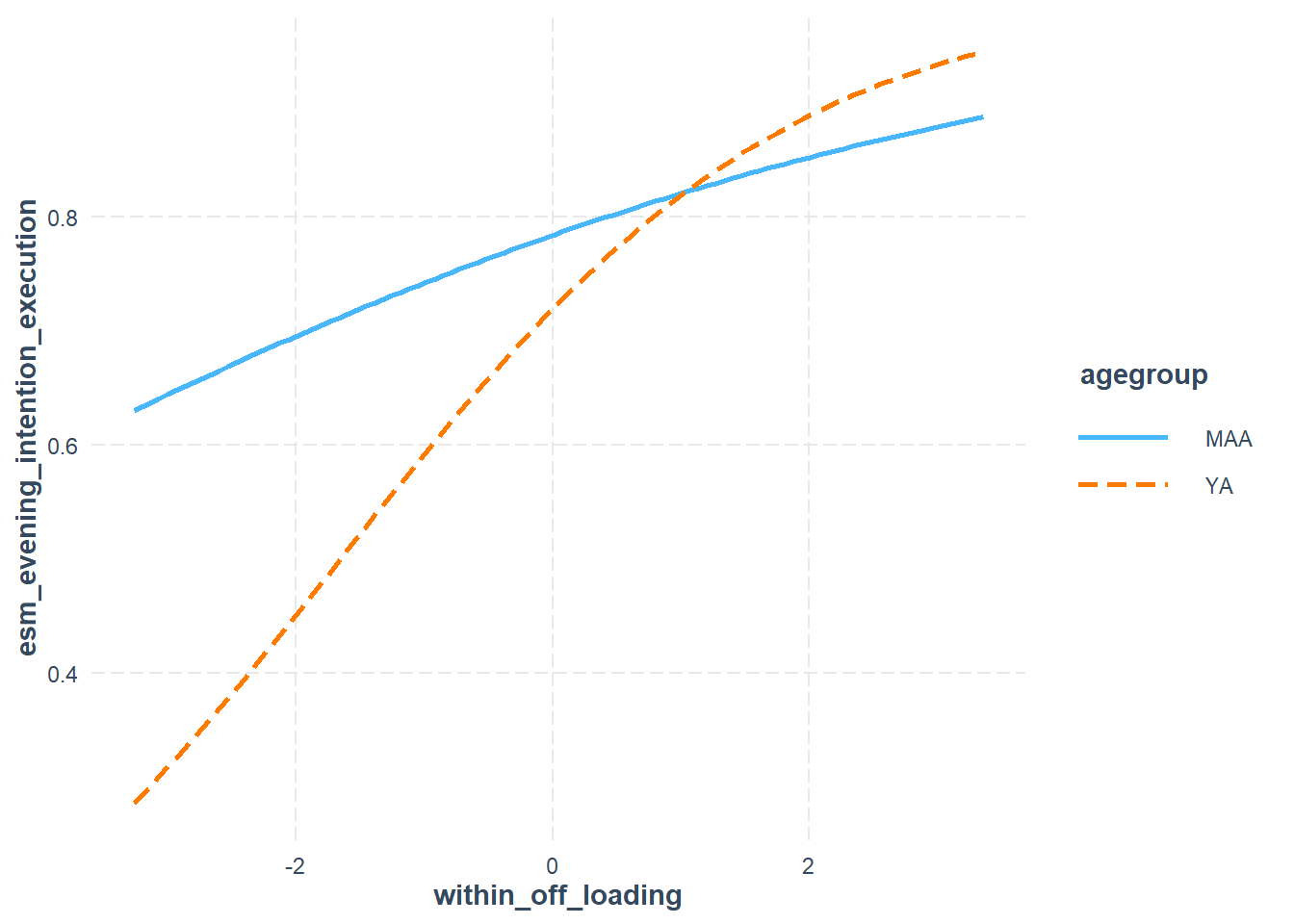
Plot moderation

Code
interact_plot(int_mod, pred = within_off_loading, modx = agegroup)

Code
# # get the posterrior samples
# draws<-posterior_samples(fit1)
# 
# # Compute indirect effect manually
# draws$indirect <- draws$b_withinoffloading_within_importance * # path a - M~A
#   draws$b_esmeveningintentionexecution_within_off_loading  # path b - Y~M

# # plot distribution
# ggplot(draws, aes(x = indirect))+
#   geom_histogram()+
#   theme_classic()+
#   gg_title("posterior distribution indirect effect of intention on PM")

#indirect_bf <- bayesfactor_parameters(draws$indirect)

#plot(bayesfactor_parameters(draws$indirect))

# draws$indirect2 <- draws$b_withintaskmonitoring_within_business*  draws$b_esmeveningintentionexecution_within_task_monitoring 
# 
# 
# hist(draws$indirect)
# 
# hist(draws$indirect2)
# 
# # simple slope analysis for the interaction between age group and within task monitoring
# slope_MA <- draws$b_esmeveningintentionexecution_within_off_loading  +
#   draws$`b_esmeveningintentionexecution_agegroup.c:within_off_loading` * 0.5
# slope_YA <- draws$b_esmeveningintentionexecution_within_off_loading  +
#   draws$`b_esmeveningintentionexecution_agegroup.c:within_off_loading`  -0.5+0.5
# 
# describe_posterior(slope_MA)
# describe_posterior(slope_YA)
# 
# conditional_effects(fit1, "within_off_loading", resp = "esmeveningintentionexecution")
# 
# ce <- conditional_effects(fit1, effects = "within_off_loading:agegroup.c",
#                           conditions = data.frame(agegroup.c = c(-0., 0.52)))
# 
# plot(ce)

# stronger in young adults than in middle aged adults

Posterior predictive check

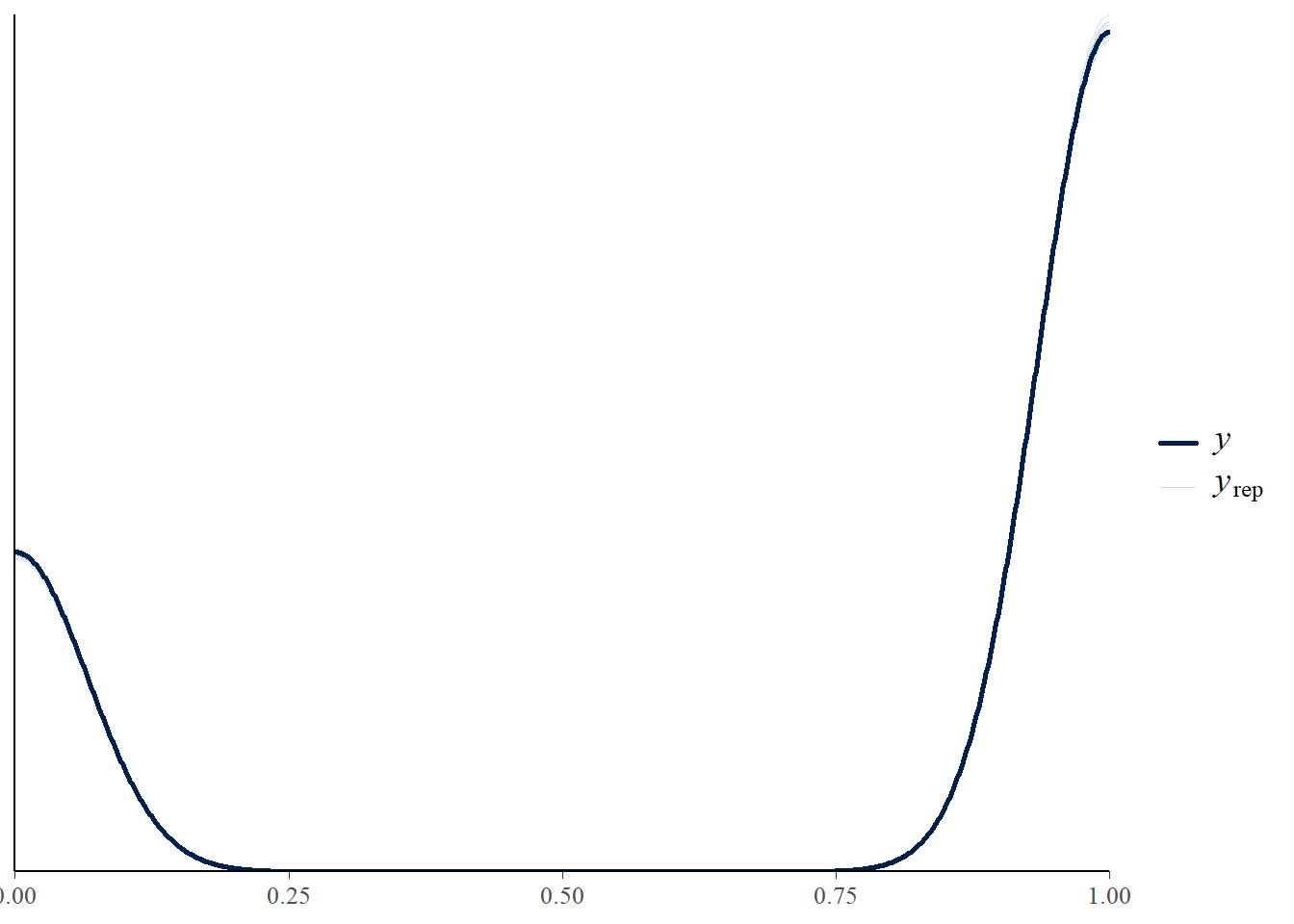
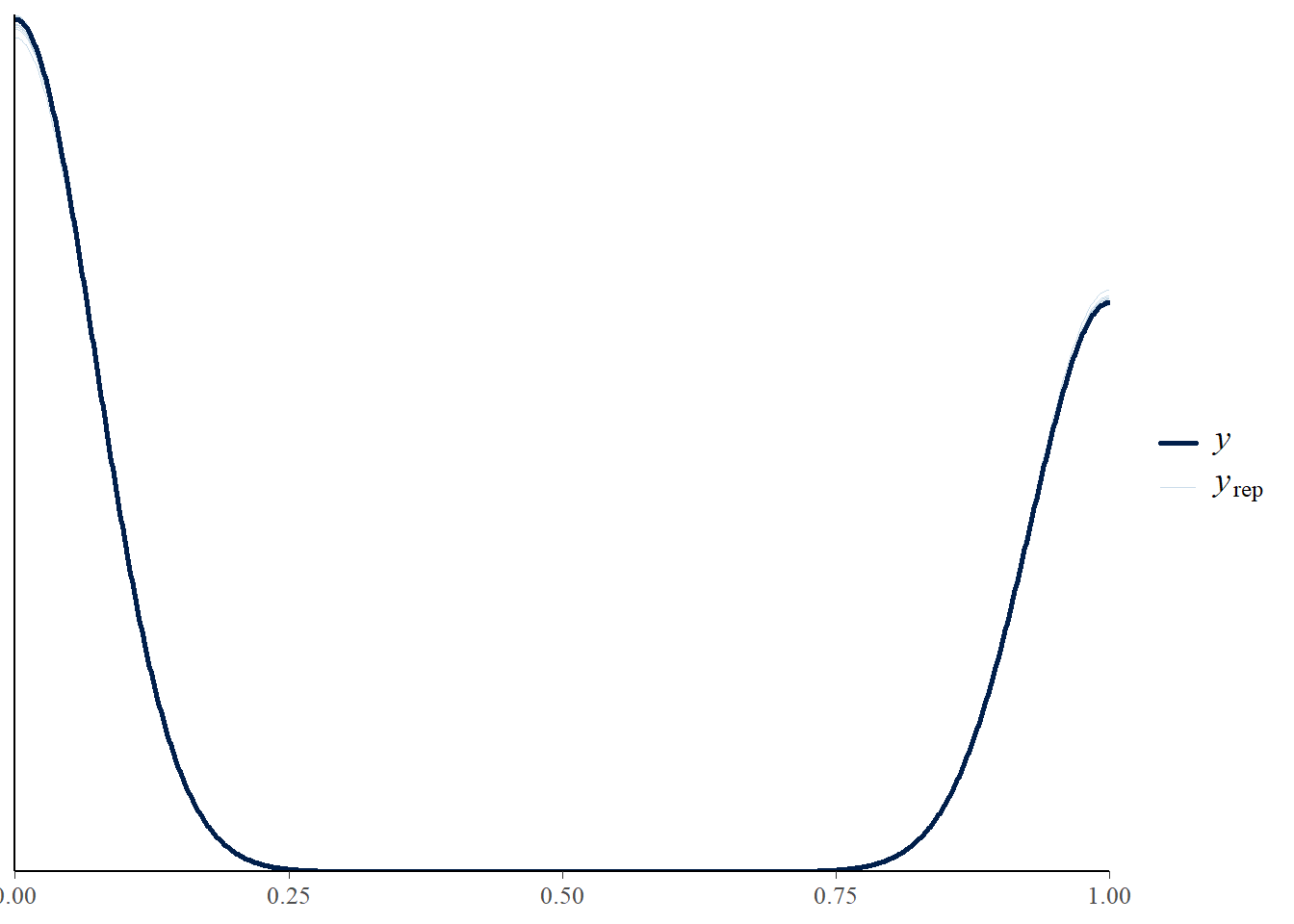
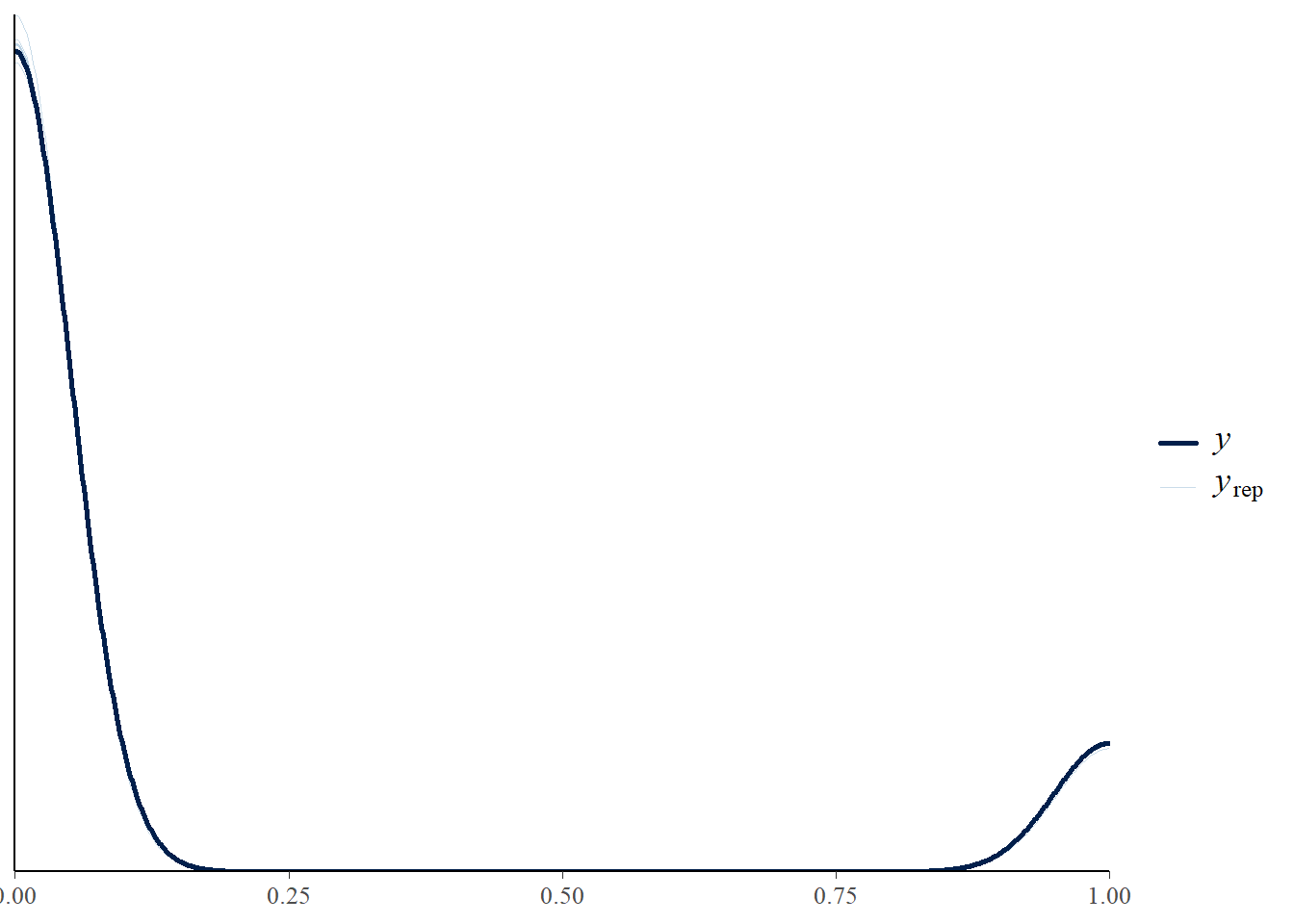
PPC constructs the posterior distribution over the parameters and simulate their distribution - if it approximates the distribution of observed data, the model is a good fit

Prospective memory

Code
pp_check(fit1, resp = "esmeveningintentionexecution")
Using 10 posterior draws for ppc type 'dens_overlay' by default.

Posterior predictive check

Task Monitoring

Code
pp_check(fit1, resp = "esmdaytaskmonitoring")
Using 10 posterior draws for ppc type 'dens_overlay' by default.

Posterior predictive check

Off Loading

Code
pp_check(fit1, resp = "esmeveningoffloadingr")
Using 10 posterior draws for ppc type 'dens_overlay' by default.